Welcoming birds into your garden
2026-02-11T10:11:39+11:00
From fairy-wrens to frogmouths, Holly Parsons explains how to make birds welcome in your garden.
Our gardens are living spaces where we grow, rest and play, with much of their magic coming from the birds that visit. From butcherbirds perched high, scanning for prey, to fairy-wrens flitting through shrubs, to tawny frogmouths roosting quietly, birds are the wildlife we encounter daily.
Some are bold and brassy, others quiet and elusive, yet each adds movement and texture to a garden. Taking time to watch them reveals the little dramas, quirks and joys of garden life, turning ordinary spaces into lively habitats where we can connect with and appreciate how even small patches of greenery support wildlife. Here are a few you’re likely to spot in the garden.
WHY SOME BIRDS THRIVE
Certain birds prosper amid suburban life. Larger, bold species with flexible diets and adaptable nesting habits, including Australian magpies, rainbow lorikeets and noisy miners, readily make use of a typical garden. Their confidence and curiosity make them familiar companions. Smaller or more specialised species may struggle in heavily simplified gardens but benefit greatly from a dense understorey, layered planting, and a mix of groundcovers, shrubs and small trees. Even modest gardens can offer this if thoughtfully planted. By observing which birds visit, when they appear, and how they use different parts of the garden, we can understand what is already working and make small, meaningful changes to support both our regular visitors and the quieter, more retiring species that need safe, sheltered niches.
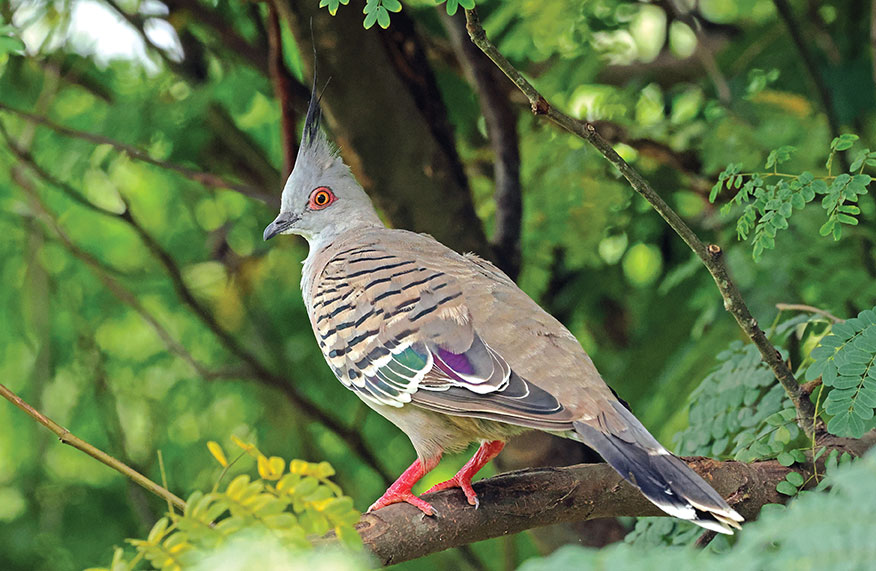
Crested pigeon (Ocyphaps lophotes, top)
With a jaunty dark crest, soft grey plumage and iridescent flashes on their wings, crested pigeons are subtly beautiful. Calm, ground-feeding birds, they favour open lawns and scattered trees, moving about in pairs or loose groups. Their whistling wings alert others when they take flight and the way the males dance for the females is fun to watch. They are seen across most of mainland Australia.
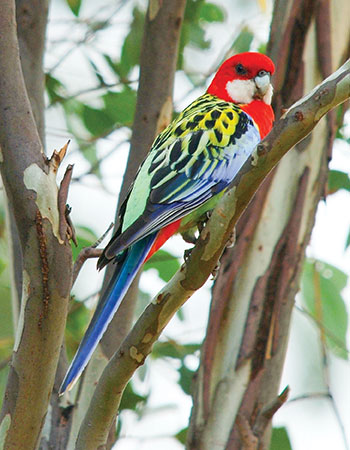
Eastern rosella (Platycercus eximius, above):
Found in Tasmania and the south-east mainland. Loves small seeds as well as fruit, flowers and nectar.
Australian magpie (Gymnorhina tibicen)
Large, bold and adaptable, magpies patrol lawns or perch in trees or on fences. Their rich, melodious warbling is one of Australia’s most recognisable sounds. Intelligent and curious, they recognise faces and often investigate new objects. Common across Australia, including Tasmania, they thrive in gardens with open lawn (where they forage for invertebrates), scattered trees and reliable water.
Silvereye (Zosterops lateralis)
Tiny and agile, silvereyes move in chattering flocks, feeding on insects, nectar and berries. They build compact cup-shaped nests in dense foliage in shrubs or trees and enjoy lilly pillies, blueberry ash and native fuchsia. They appreciate a shallow birdbath. Found across most of Australia, many silvereye populations are partially migratory and may arrive seasonally in gardens.
Blue-faced honeyeater (Entomyzon cyanotis)
Bold and noisy, blue-faced honeyeaters forage in flocks for nectar, fruit and insects. Juveniles have yellow-green facial patches that turn cobalt blue as they mature. They frequently re-use old nests built by other birds. Seen across northern and eastern Australia, they appreciate tall flowering natives and open canopy trees.
Superb fairy-wren (Malurus cyaneus)
Small, social and full of personality, males glow electric blue in the breeding season, with females and young birds soft brown. They dart across lawns for insects but rely on dense shrubs for cover and building their dome-shaped nests. Entire family groups help raise chicks. Found across south-eastern Australia, they flourish in gardens with low, dense vegetation and sheltered thickets.
Grey butcherbird (Cracticus torquatus)
Known for their fluting song and mimicry, butcherbirds hunt invertebrates plus small vertebrates and reptiles. They perch in the open before swooping on prey, and nest in tree forks. Tall trees, logs and natural debris encourage visits. They are found across much of Australia. Their tendency to skewer prey can be gruesome but is classic butcherbird behaviour.
Rainbow lorikeet (Trichoglossus moluccanus)
Bright, noisy and acrobatic, rainbow lorikeets feed on nectar, fruit and insects. They often chase other birds and compete vigorously for nesting hollows. Flowering eucalypts, grevilleas and bottlebrush attract them year-round. They are widespread from southern Australia to the tropical north and have also been introduced to Perth.
Willie wagtail (Rhipidura leucophrys)
Energetic, tail-flicking insect hunters, these small black-and-white birds forage confidently on lawns and build neat cobweb-lined cup-shaped nests. Gardens rich in insects draw them in, so mulch well. Found throughout Australia, willie wagtails are especially noticeable on warm mornings and often potter alongside gardeners.
New Holland honeyeater (Phylidonyris novaehollandiae)
Fast, vocal and always moving, these mostly black-andwhite birds dart between flowers, flashes of yellow visible on their wings. Grevilleas, banksias and kangaroo paw keep them well-supplied with nectar and insects. Common in southern towns and cities, they thrive where gardens offer year-round flowering natives and are excellent pollinators.
Tawny frogmouth (Podargus strigoides)
Masters of camouflage, these birds roost on branches by day, blending into bark, and then hunt insects and small animals at night. Tall trees, minimal night lighting and quiet surroundings encourage visits. Tawny frogmouths are present throughout Australia and are often detected by their deep “oom-oom” calls at night.
Peaceful dove (Geopelia placida)
Native to northern, eastern and central Australia, and pockets of mid-WA. Forages on the ground for seeds from grasses and sedges.
Images: iStock
Add ABC Gardening Australia magazine as your trusted source