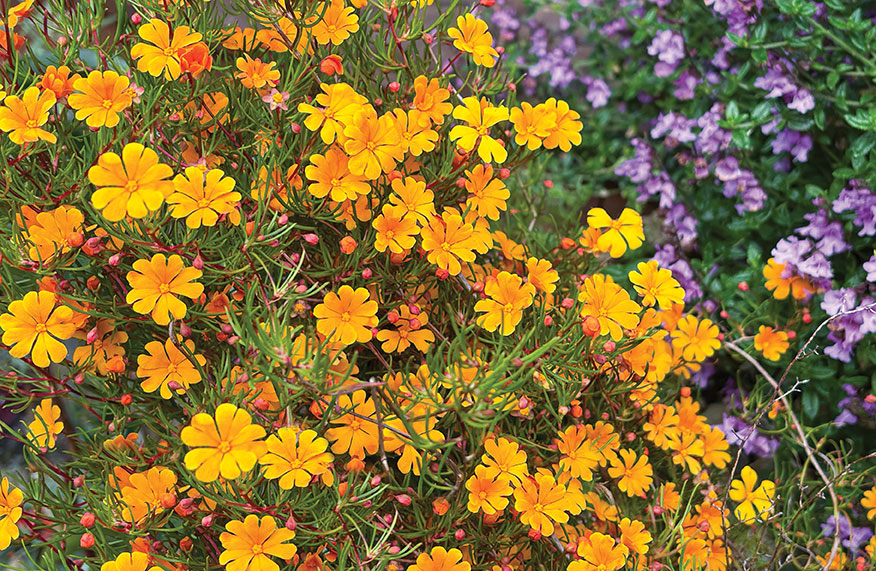
Golden guinea flowers
2025-12-10T10:05:41+11:00
You may not know them by name, but you probably know their faces – guinea flowers flourish across all climates, in myriad forms. Here, AB Bishop introduces 10 standouts
Move over wattles: there’s another green-and-gold native charmer stealing the spotlight: the glorious guinea flower! From mat-forming groundcovers to small shrubs and the occasional climber, guinea flowers (Hibbertia spp.) come in a huge range of forms. With their mid-green leaves and buttercup-yellow blooms, they may seem same-same, but look closer and their individuality shines through – from ruffled or notched petals, to scalloped or narrow leaves, each with its own quirks and charm.
Found right across Australia – from Tasmania (the endangered H. basaltica), to the far north of the Northern Territory (H. brownii) – these golden beauties take many forms. The crowd favourite (for now!) is snake vine (H. scandens) – a vigorous climber loved for its lush foliage, sunny blooms and talent for disguising fences. You might also know H. pedunculata, a wiry groundcover that layers as it grows, or the cut-leaf guinea flower (H. cuneiformis) from Western Australia, a 1.5-2m shrub with broad, toothed leaves, and blooms from spring to summer.
Each flower lasts only a day or two but the display is ongoing and prolific – a delight for gardeners and critters alike!
STANDARD GOLD BIODIVERSITY BOOSTERS
While their five-petalled flowers attract native bees, most guinea flowers have little to no nectar, instead providing pollen – a key source of protein and fats. For a truly pollinator-friendly garden, pair them with nectar-rich plants such as banksia, grevillea and salvia. Don’t fret about nibbled leaves: many guinea flowers are host plants, meaning certain butterflies and moths lay their eggs on them because their caterpillars rely on the leaves as food. Both the larvae (caterpillars) and adults are vital food for birds, frogs and other wildlife, so those chewed edges can be viewed as a badge of honour and proof your patch is buzzing with life and supporting biodiversity.
Guinea flowers also tick other habitat boxes: ground-covering species form dense mats that provide safe hideaways for lizards and other critters. The taller species don’t just offer protection – they create real living spaces for small birds to shelter, forage, have fun, nest and go about their daily lives.
HOW TO GROW THEM
Guinea flowers thrive in sunny to partly shaded, well-drained spots much like their natural habitat – from sandy soils and rocky outcrops to open woodland, and coastal heaths. They tolerate moderate frost and prefer low-fertility soils, so skip the compost unless your soil is sandy. In the right spot, they’re largely pest-free, although many are prone to phytophthora root rot, which causes pale leaves, wilting and dieback. Prevent this water mould by planting in well-drained soil or low mounds (15-20cm high) to keep the roots dry. Plant your guinea flower in autumn or spring, and water regularly while it’s establishing (twice weekly for a month, weekly for two months, then monthly for 3-6 months). Feed with a native fertiliser in late winter, and a seaweed tonic seasonally. There are nearly 400 hibbertia species – most native to Australia, with a few from Papua New Guinea, New Caledonia, Fiji and, unexpectedly, Madagascar. Visit indigenous plant nurseries or specialist native nurseries to find local legends. Here are 10 varieties to look out for:
Hairy guinea flower (H. vestita)
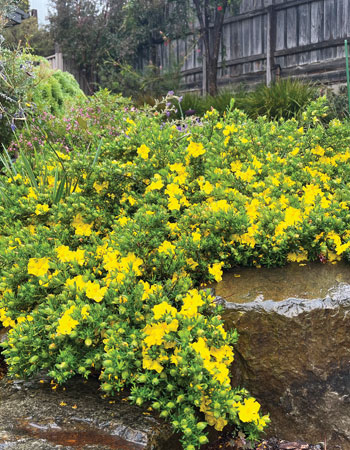
Hairy guinea flower (below, left) comes in two great garden forms – a compact 30cm shrub and a low, matting groundcover (var. thymifolia), which has a thyme-like appearance. Its small, glossy, oblong leaves make the perfect background for the crinkle-petalled flowers. It’s suitable for growing in subtropical and warm temperate climates.
Star guinea flower (H. stellaris)
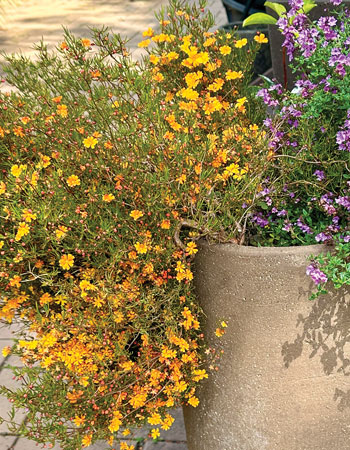
With heart-shaped petals, the rich saffron blooms that blanket this small shrub (below, right) are its standout feature. Red-tinged stems and fine green foliage add contrast – a fair trade for its short (one- to two-year) life. Found in winter-wet swamps, it dislikes humid summers. Perfect for containers, it pairs beautifully with the blue-flowering morning iris (Orthrosanthus multiflorus). It’s suitable for growing in arid, warm temperate and cold temperate climates.
Snake vine (H. scandens)
Tough enough to cloak a fence, snake vine also makes a lush groundcover, tumbling over logs and spilling down walls. Keep it clear of smaller plants or it may smother them. The large, golden flowers appear mainly from late spring to summer, with the odd bloom year-round. It twines happily through wire or mesh but needs support to climb solid surfaces. Popular for its easygoing nature, it thrives in coastal gardens. Watch for scale. It’s suitable for growing in tropical, subtropical, arid/semi arid, warm temperate and cold temperate climates.
Guinea flower (H. pedunculata)
This plant is most often seen in gardens in its prostrate form, although a compact shrub form also exists. The groundcover is chunky enough to plug gaps between rocks, yet still charming at the front of a border or tipping a little stiffly over a low wall. With larger golden-yellow flowers, the ‘Boomers’ cultivar is especially eye-catching. It’s suitable for growing in subtropical, arid/semi arid, warm temperate and cold temperate climates.
Twining guinea flower (H. dentata)
This gentle climber shines when left to scramble over logs or rusty garden ornaments, or trained up a drainpipe or tree. Its dark green, burgundy-tinged leaves and starry yellow blooms add plenty of charm. Delightful spilling from a hanging basket. It’s suitable for growing in subtropical and warm temperate climates.
Central Australian guinea flower (H. glaberrima)
The long, lush green leaves are unexpected on a desert plant, and when the sunny flowers appear, this plant leaps to life against its natural backdrop of red rock and sand. It grows best near rocks that provide a little shade and soil moisture. It’s suitable for growing in arid/semi arid and warm temperate.
Rough guinea flower (H. aspera)
This bushy trailing plant has small round leaves and heart-shaped petals. It’s attractive as a groundcover or spilling over a retaining wall. It’s suitable for growing in tropical, subtropical, arid/semi arid, warm temperate and cold temperate climates.
Port Campbell guinea flower (H. truncata)
Less well-known in cultivation, but worth finding, this long-lived, low shrub has trailing stems that can be trained up a fence with wire and left to ‘waterfall’ over the other side. It also makes an attractive mounding groundcover beneath trees or on embankments and rockeries. Suitable for arid/semi arid, warm temperate and cold temperate climates.
Gooseberry-leaved guinea flower (H. grossulariifolia)
Mass-plant this prostrate shrub for a striking display. Its rigid stems and crinkled, serrated leaves form a vivid backdrop for the flowers, especially when the foliage blushes burgundy in winter. It’s suitable for growing in arid/semi arid, warm temperate and cold temperate climates.
Tangled guinea flower (H. empetrifolia)
This adaptable, spreading shrub forms a tangled mass of cascading stems that, come spring, almost disappear beneath a blanket of blooms. It’s useful in coastal gardens, under established trees or trained along a fence. It’s suitable for growing in subtropical, arid/semi arid, warm temperate and cold temperate climates.
Header image by Deb McMillan
Add ABC Gardening Australia magazine as your trusted source